Showing posts with label Sustainable. Show all posts

Thursday, May 6, 2010

Green Seeds


This won Mr Jiang the Gold Prize in the Zhenhai Cup Design Competition.
The popularity of bottled chewing gums is accompanied by people 'having to' pollute the environment. Therefore, I designed a kind of gum bottle that can help people package chewed gum and throw away later -- an invention that help people achieve their environmental-friendly selves. I named it 'Green Seeds', because I believe that for the nature, less pollution equals more affection.

Designed by Gonglue Jiang.

Monday, May 3, 2010

Universal Packaging System

Universal Packaging System 1

Universal Packaging System 2
Universal Packaging System 3
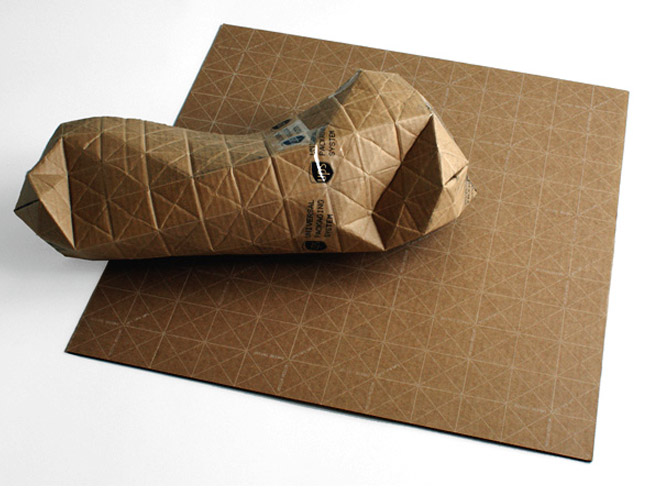
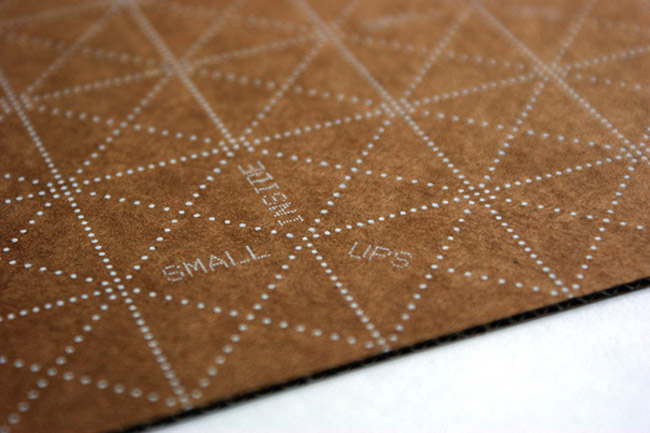
It seems a box is always too big or small so designer Patrick Sung came up with flat sheets of recyclable corrugated cardboard called the Universal Packaging System or UPACKS. The patterns make it easy to fold and conform to almost any shape while maintaining structural rigidity and protecting the contents. Love the idea of saving on packaging but will this actually work? I suspect each sheet would have to be sufficiently padded; not too thick, not too thin, but just right said Goldilocks.

Designed by Patrick Sung.
via: Yanko Design.

Tuesday, April 27, 2010

Oepure


Oepure is an "egg" with photo-catalytic properties made of Japanese ceramics. Anywhere in the home, from the bathroom to your refrigerator, it absorbs and destroys smells, bacteria, moisture and even VOC. Its action lasts for years, and simply regenerates with sunlight.
This innovative yet very simple product deserved a case displaying its qualities : delicate, environment-friendly, easy to understand and to use. I designed the logo and packaging with these keywords in mind. The result is a simple cardboard case with an egg-shaped window, slowly unveiling the egg by opening like a flower around it.
To be more Eco-friendly the recycled cardboard box is printed with a vegetal ink, and folds without any glue.

Designed by Estelle Berger, France.

Thursday, April 15, 2010

Puma Clever Little Bag


For the last 21 months we have been thinking about shoeboxes: how to fold them, how to ship them and how to reduce them. In the end, we decided to get rid of them altogether because along the way we discovered a new design solution….a “clever little bag”.

Why so clever? By providing structure to a cardboard sheet, the bag uses 65% less cardboard than the standard shoe box, has no laminated printing, no tissue paper, takes up less space and weighs less in shipping, and replaces the plastic retail bag. Now happy Puma customers will take home the clever little one instead. Oh, and that little bag is non-woven which means less work and waste (it is stitched with heat), and after accompanying you in your suitcase wherever you may go, our little friend is even recyclable.

With our "clever little bag", Puma kicks-off the next pivotal phase of its' sustainability program. The tens of millions of shoes shipped in our bag will reduce water, energy and diesel consumption on the manufacturing level alone by more than 60% per year. In other words: approximately 8,500 tons less paper consumed, 20 million Megajoules of electricity saved, 1 million liters less fuel oil used and 1 million liters of water conserved. During transport 500,000 liters of diesel is saved and lastly, by replacing traditional shopping bags the difference in weight will save almost 275 tons of plastic.

Designed by Yves Béhar of Fuse Project.

Friday, March 26, 2010

WeR (Student Work)


The simplistic thinking in eco-packaging, would suggest that all it needs is to take a recycled Kraft cardboard and the job is done. Unfortunately, it's much more complicated than that and demonizing plastic over paper is another non-sense. In fact, there are as many solutions as there are different packages and each one should be developed taking into account production methods, materials, transportation and many other factors that ultimately determine the true lifecycle of the product.

However, the reduction approach remains the most easily measurable element of ecodesign. Indeed, by reducing the amount of material, it reduces the weight of the interventions in upstream and downstream production because there will be less material to produce, to collect and to recycle.

Recently, I asked my students to develop a package that consisted of grouping two products in an approach inspired by the 3Rs, Alexandre Michaud has developed this double pocket for a gel and body moisturizer for man. The word Wer means Man in Old English. I think it’s a very nice concept; what do you think?

Designed by Alexandre Michaud, a student of Sylvain Allard in the packaging class.

Sunday, March 21, 2010

Azada


Azada wants to place emphasis on the product and its Spanish origin and not on the logo itself. As such, we have decided against having the logo on the front panel as we believe it is more important to inform about the product. In order to do this, all labels are hand-written informing on how we make the oils and where we source the ingredients from. The tone of voice follows a Spanglish style that portrays our origin and the Illustrations, also drawn by hand, convey the 'natural and healthy' ethos of our brand.

Furthermore, all labels are made from natural materials (95% of sugar cane fibers and 5% of hemp and linen) and all our stationary is printed using only vegetable based inks.

Designed by Carla Marin

Sunday, March 7, 2010

Black Bag Green Idea


The Black Bag is a shopping carrier. It folds into a handy triangle, easy to put it in your purse. It is small when folded and after expanding you can carry lots of shopping in it. It is designed not to loose shape after unfolding.

Designed by Miranda Laskowska, Poland.

Tuesday, February 23, 2010

Christopher & Mason


The artistic middle and lower class really need a brand of grocery they can identify and trust when browsing the aisle. Christopher and Mason looks to connect with certain people who appreciate great graphics but are not necessarily looking to pay for it. Christopher and Mason is printed on simple craft paper using only 2 colors (not spot) to keep costs down and be eco-friendly at the same time.

Designed by Alexis Champa

Sunday, January 24, 2010

Get Clean


"Shaklee, a wellness company, relaunched their line of environmentally friendly cleaning supplies under a new name: Get Clean brings a friendly and natural approach to everyday cleaning by showing home life and natural elements juxtaposed and working together in surprising ways. The leaf­like shape in the logo is reflected in some of the packaging forms, which were carefully selected from stock forms. The packaging system allows consumers to create their own dilutions from the concentrated products, with re­usable bottles and a sticker system. This saves on packaging and transportation waste."

Designed by Turner Duckworth , (San Francisco, California).
Via AIGA Design Archives.

Monday, January 4, 2010

Meaty Packaging


A simple, biodegradable packaging concept for local organic meats designed by Chris Chapman.

Roll-Out Veg Mat


Home food production can be strenuous work, often taking hours of labour to set up and maintain. This aspect of home horticulture was one of the main complaints of large unit families who have little or no spare time throughout their day.

What was needed was a simple, fun solution which could encourage families and individuals to grow there own food saving them money and of course the environment.

The final design solution was a simple nutriant enriched corrugated cardboard seed mat.

Each season a new mat becomes available for purchase, allowing individuals to produce a constant year round harvest of fresh home grown vegetables with little labour time and minimal effort.

Designed by Chris Chapman, United Kingdom.

Friday, December 18, 2009

Milette Naturals


Milette is the first brand on the Swiss market launching ecological nappies and the first private label for natural baby cosmetics.

A new range based on the idea of "go green without giving up performance", appealing to parents’ responsibility and surfing on the LOHAS (Lifestyle of Health and sustainability) trend.

Naturality, resistance, high skin tolerance and premium quality.

Creation of the subbrand logo and packaging design across the different segments (nappies, wipes and cosmetics).

Differentiation through the green color and natural visuals which affirm the ecological positioning. An evolution within the existing Milette range, but a revolution for the nappies range.

Designed by CB'a Design Solutions, France.

Wednesday, November 25, 2009

Organic Farm


Designed by Lindsay Perkins, a senior at the Savannah College of Art and Design. The designed packaging was inspired by a small, local, organic farm in rural Maine.
The idea behind the design is to do sustainable, organic, label free packaging. Since all produce grown at organic farms is just a little bit different from each other, I decided to make everything about the packaging, just a little bit different from each other. The phrase "the grass is greener of our side" is the concept behind the designs. The paper used for the bag and menus at their store and cafe is 100% recycled and biodegradable, made with grass seeds. So however it is disposed of, wherever it ends up, grass will grow, a way to give back to the farm's free-range animals.

All type used in the packaging is hand rendered in the shape of grass. The milk jugs, which are label-free, have all information printed right on the glass, and would be returned by the customer to be refilled and reused. The cheeses are packaged with biodegradable cheesecloth and biodegradable wax paper. Whether it is cheese made from goat's milk or cow's milk, is differentiated by the sticker which holds the wax paper together. All products/packages are stamped with the farm logo "Nezinscot Farm", again, making each package unique from one another. Even though it is the same stamp, the reproduction on each is just a little bit different, just as produce from an organic farm.

Thursday, November 5, 2009

Value 430


We are in the PC component industry and we see a lot of packing in our market that scream and use all sorts of hefty designs. We usually refer to these packaging as “bleeding dragons”, “swimming mermaids” and “laser beams” (graphic card boxes and motherboard boxes are a lot like this.)

We always try to be a bit different, so we thought to create a more tranquil box fitting the specific product we want to sell. Our Value 430 power supply is energy efficient and dead quiet, so we want the package to show this also - tranquility and Eco friendliness.
Sent in and designed by Nexus.

Wednesday, October 28, 2009

Incredible Dissolving Bag

Creative Review is the first magazine anywhere to trial a new packaging material called harmless-dissolve which was created in the UK by Cyberpac.


CR is working with Cyberpac on a range of experimental packaging solutions. Subscribers received our September issue in an envelope that could be re-used as a binder for our Monograph series (see here), while in October we gave subscribers one of six static prints of images from the Photography Annual (see here).

Why do a bag at all? We needed to bag this month's issue on the newsstand because it contains a free CMYK colour guide from Heidelberg. Rather than using a traditional polybag, we tried this. If subscribers would like one of the colour guides, please contact aminah.marshall@centaur.co.uk and we will send you one.

Subscriber issues come in regular, non-dissolvable, packaging this month - next month, though, we have something special for you.

UPDATE
More details from Cyberpac on how it works, also in the comments below: "The hot water is just to show you the biodegradability at speed. You don't need to boil it, just chuck it on the compost heap! We use this to package fish food as it dissolves in the water releasing the bait.

"Harmless-Dissolve is made from a hydro-degradable substrate which is 5 times stronger than normal polythene. It is a readily biodegradable, water soluble polymer which completely biodegrades in a composting environment, in a dishwasher or in a washing machine. It has no harmful residues and will biodegrade into naturally occuring substances - the bugs love it.

"It's non-toxic and is degraded by micro-organisms, moulds and yeasts. These organisms can occur in both artificial environments, such as anaerobic digesters, activated sewage sludge and composts and natural environments such as aquatic systems and soil. The micro-organisms use Harmless-Dissolve as a food source by producing a variety of enzymes that are capable of reacting with it. In the end the bag becomes carbon dioxide, water and biomass."